Wednesday, May 9, 2007
Thanks

Monday, April 16, 2007
Street Festival, Japantown Style
 Thousands of people flooded Post Street between Fillmore and Gough for the opening weekend of the 40th Annual Northern California Cherry Blossom Festival last Sunday. The first thing any visitor to Japantown will notice about their celebration of the blooming of the cherry blossoms is how tame it is in comparison to other public parties in the city. While an event like the Bay to Breakers is a celebration of our city's special ability to integrate debauchery and running, the Cherry Blossom Festival was a celebration of Japanese culture and showcased a far more wholesome set of skills. On the main stage, children performed a few basic karate manuvers to the delight of their parents and one onlooker who clearly was just sticking around to see if the kids were really going to start brawling. They didn't. In fact, there would not be any shenanigans. The freak quotient was well below the standards I've come to expect. That said, I did manage to find a grown man dressed as what I can only assume is a Power Ranger.
The defining characteristic of the event came in the form of the event's sponsors whose white tents lined Post and forced visitors to run a blocks long gauntlet of barkers who harangued passers-by to provide them with personal information in exchange for low quality freebies. Not even cries of "I'm walkin' here!" in a heavily affected Brooklyn accent could ward them off. Their presence varied from obnoxious to creepy, with one booth promising to turn your eight-year-old into a modeling superstar.

For the kiddies who want to act their age, there was the Children's Village which provided the young ones with a "jump house." A term I managed to discover by googling "inflatable jumping around thing," which I would argue goes much further in explaining its purpose. Based on the miserable faces of the children leaving the General Mills-sponsored inflatable jumping around thing, the event was of a dud for children of all ages.
That said, and in fairness to the event's organizers, I may have been the wrong weekend to happen upon these particular goings-on. The real show takes place on April 22 at 1 pm with a parade from City Hall into the Western Addition which will feature, among other things, a sake barrel shrine float which will be carried by an estimated 100 people as the festivities make their way into Japantown. However, despite what we might expect from the other street festivals, I don't suspect they'll be cracking that barrel open once they arrive on the scene. It is the prerogative of the organizers to have a family-friendly affair, and they have exercised it. You've been warned.

Wednesday, April 11, 2007
5:23 AM
Harrington's challenges are running her business while on the road and maintaining her health. She says that a sense of humor is essential. Her advice to writing hopefuls is to get a staff position to learn the ropes and to build up a network. "never, ever stop marketing yourself. Writing is the easy part -- selling yourself is harder." Harrington is the editor of the magazine "Emerging Horizons," which is a resource for people with physical disabilities who travel.
I really enjoy the advice and the people the kiwi writer seeks out to interview and we can learn a lot from her and her interviewees.
On International Affairs

BuzzMachine had an interesting post that captured my attention not so much because of the content, but more so the response it received. The blog itself is concerning the optimism that European Media has in regards to the future of News.
Now, I realize that Internet is universal, it is globalized, packaged and marketed to mankind everywhere but… this failed to fully register until I read a comment from a German blogger responding to what Jeff Jarvis had written.
Hmm… will we here at USFblogtastic attract an international audience? We can only hope so. Something else I was considering was language barrier. How long will it be before there is a link we can hit on blogger to instantaneously translate the blog into any desired language? (Or does that already exist?)
In Regards to Mapping: I am definitely a fan of Platial mapping because well, it’s “The Peoples Atlas”. And it truly is, the detail one can include in Platial maps is astounding. It isn’t just any map; Platial is a handbook to your neighborhood, city, state, and world. You can find a good restaurant around your block on Platial OR you can look up an obscure city in some foreign country thousands of miles away.

Monday, April 9, 2007
Adventures in Outsider Retail
 They're known by many names: flea markets, swap meets, bazaars, dirt malls. Each one conjures up thoughts of card tables with junk piled on top, beneath and all around, in short an outdoor version of Fred Sanford's house. And each one sounding unsavory enough to manage expectations and not gloss over the fact that most of this stuff was, to at least one person prior, trash. Not that its a bad thing, some people embrace, even revel in that fact-- I do.
In operation since 1996 and located in Bernal Heights beneath the junction of 101 and 280, the Alemany Flea Market is no different. According to Gary Gentry, who oversees the administrative operations of the flea market, 8,000 to 10,000 people visit the market's 150 to 250 vendors every Sunday between 5 am and 5 pm.
As diverse as the array of antiques, clothes, food and old-fashioned flea market junk is, the individuals who accumulate and sell the stuff are often the real attraction. "He's not here today," said Gentry, "but there's a guy who brings all kinds of weird stuff: caskets, mannequins. Actually, he'll even carve a mannequin's head to resemble your face." Uhh, alright. Actually, my reaction at the time was that I was sorry to have missed out. Upon further reflection, however, I decided having a mannequin with my face carved into it might not be the irresistible conversation piece it first seemed.
 For many of the sellers, this is how they make their living. George Feldman has been at it 50 weeks a year for 23 years (taking into account the customary two weeks vacation). Today, he had spread out on his table an array of earthenware vessels, some of which were said to be 600 years old. That came as something of a shock to me as my flea market experiences in New Jersey mostly involved people selling at low, low prices things that had fallen off the backs of trucks (wink). However, his potential buyers didn't even flinch when he made a price of nearly 400 dollars for a set of two-foot tall vases. He is a regular at flea markets all over the Bay Area and for him, market day is a borderline religious experience. "The breath of life is in the market culture. There's communication; there are thousands of years of history behind this."
Not everyone out here sells Michael Delane has been a firefighter for 36 years, but likes selling as a hobby in his free time. "It gives you peace of mind," said Delane, "interacting with people. The connections you develop with other sellers, its almost like a functional dysfunctional family."
Then there's Jose Jimenez, the skittish belt salesman who, after one question, was (hilariously) asking for his lawyer. Not only that but he didn't even make an effort when providing me with a phony name. When I asked him for confirmation on the spelling, he just looked at me blankly and said, "Um." On our separation, my parting, "Take it easy, Jose," didn't register even a flicker of recognition on his face. Its always better when the performer doesn't break character.
The Alemany flea market, the one thing this wide range of strange and wonderful people have in common, is widely considered to be the premiere weekly market in the area (a monthly flea market held on an airstrip in the naval base at Alameda was described as being between four and ten times the size of Alemany). Feldman, who frequents weekly markets up down the peninsula declares this the best market in 100 miles. "A good market develops when a consensus is formed," he explained. "You need people who have quality items to sell, and you need people who appreciate it-- and have money." And with the unsavory connotations of the word embraced, this flea market delivers.
Wednesday, April 4, 2007
A Gardens Hidden Memoir

Retching and reeling, San Francisco revels in its caucophony. An insomniac, the city never sleeps and its residents are perpetually caught in its restless grip. Needless to say, quiet space and an area for reflection are a rare find. It was only after I had allowed my weary limbs to sink into the garden bench in the Jesuits secret garden that I truly became aware of the treasure USF had tucked away.
After lightly scoffing at Father Tom Lucas’s claim that gardens recall childhood memories, I found myself zoning out, recollecting an era that seemed an eternity ago. A time where I sat under a Peony bush and played with earthworms, allowing their grotesquely squishy bodies to slime around my dirt encrusted fingers.
Part of the gardens understated beauty lays in its simplicity and basic design. Nothing about the secretive spot screams Martha Stewart, there are no exceedingly rare plants, the space is reserved in its layout and the fountain is anything but gaudy. “That garden just has good bones, it was thoughtfully put together”, said USF’s head gardener Robert McNeil. However, rooted primarily in remembrance this obscure garden treasures a piece of artwork that for varied reasons highlights its Jesuit values.

A terracotta piece of Our Lady Guadalupe was almost overlooked before Father Lucas drew our attention to it. Framed by carefully maintained ivy, the story behind Guadalupes calm demeanor only added to the gardens overriding theme of reflection.
Gloria Osuna Perez, mother and artist, was the creator of the beautiful terracotta piece residing in the Jesuits garden. Father Lucas had gone to one of her (many) exhibits and fell in love with her art, “I approached her at her last exhibit, she went home, did the Lady Guadalupe and it became the last piece she ever did.”

A victim of ovarian cancer, Perez died in 1999 her artwork outliving her fond memory. Two of her works can be found on campus but only the Terracotta is real. And so, instead of placed on a wall in a gallery or put behind glass, Perez’s last piece is exactly where it should be. Placed directly atop the former center of the City of Dead, and in the current heart of USF’s secret garden of musings.
A Garden Close to Heaven
 It doesn't contain fairies or even unicorns, but the garden located at Loyola House where the Jesuits reside is, according to Fr. Tom Lucas, "pretty magical." Hidden behind 6-foot-tall ivy covered walls is a secret garden where only a select few, mainly Jesuits and their guests, have stepped foot in. Only the soothing sounds of trickling water and chirping birds can be heard while walking along the outside of the walls. It seems as if the sun is always shining here, even on a dreary day. Sometimes students can be seen tiptoeing on the stairs located beside the garden to sneak a peek inside. I must confess, when I first transferred to USF, I have tried to steal a glance through a gap at the rear gate. What is this place that has garnered so much attention, even from the raccoons, hawks, and hummingbirds? What makes it so special?
 construction of Loyola House, the garden contains italian, mediterranean, and southwestern influences. Highlighted with hedges, sprinkled with bushes and trees, as well as dotted with different pots and plants, the garden provides a little paradise. This paradise is paralleled with a spectacular view of the Golden Gate Bridge, the bay, and residential homes that line the northernmost part of San Francisco.
 The garden not only provides a serene space or fresh lemons and rosemary, it is also a symbol for life Lucas said. Like a garden, life also needs to be tended to and is a constant work. Gardens are also for memory, for remembering the past. He pointed out that at the seating area behind the chapel there is a statue of St. Joseph that was from Xavier Hall where the Jesuits used to live. Artwork can also be found on the wall there in a Gloria Osuna-Perez Lady of Guadalupe plaque; it is the last piece the artist made before she died. With its lush atmosphere, beautiful foliage, and breathtaking view, not to mention its mystery, it's no wonder why people and animals are so drawn to this place. But together with its symbolism and connections to history does this place become something truly special for those it was made for. On this place on the hill, the Jesuits can retire to relax, remember the past, reflect on the present, and look on to the future.

The Secret Garden

Nestled on the eastern slope of Lone Mountain, and overlooking the Presidio and San Francisco's famed Golden Gate Bridge, is a little known part of USF's campus, the Loyola House. Few students have ever been inside the building, and fewer still have walked around the gated garden housed therein. Father Tom Lucas, one of the Jesuits who lives in Loyola and a caretaker of its garden, drove home the obscurity of the garden when he admonished students, "Pull the gate closed, because we have to keep the secret garden secret."
Built between 1998 and 1999, Loyola houses 25 Jesuit priests, including Father Lucas and Father President Stephen Privett. The Jesuits used to live in Xavier Hall, now Fromm Hall, but Lucas said the building was too large for their needs. Several locations were scouted for a new home, and Lone Mountain was chosen both for the size of the available space and the spectacular view.
The garden attracts animal life from around the
 Bay, including 28 different kinds of birds, from hummingbirds to Red-tailed hawks, and often draws in raccoons at night. The raccoons, who have no salivary glands, are attracted to the garden's fountain because they need water to digest their food. Lucas seemed happy to host the raccoons, in spite of their tendency to knock over the papyrus plants growing in the fountain, and their penchant for eating the goldfish he occasionally places inside.
The garden attracts more than just animal life. When it first opened, the stairs going up the north side of Lone Mountain had not yet been completed, and students would sometimes stumble upon the garden when trying to scale the mountain. Lucas also related the story of a man who walked his terrier along the garden wall, and complained when Lucas asked him to stop.
 When explaining the fact that the garden is closed to the public, Lucas asked students to remember that Loyola House is the priests' private home. "Think of this place like your backyard," Lucas said. "This is our backyard. Your neighbors don't just stroll into your backyard, do they?"
Tuesday, April 3, 2007
A More Convenient Truth
 m to sparkle.
 From this tranquil space, the red peaks of the Golden Gate Bridge, a beacon of hope and new life for pioneers in the early 20th century who traveled west with gold in their eyes, can be seen. It seems appropriate that this lush garden peaks over through the trees and watches over the city daily. Looking out at the view, with a clear blue sky and perfect springtime warmth, environmental stresses were the furthest thing from my mind.
Father Tom Lucas, a Jesuit professor at USF, maintains this secret garden, as he called it, because “it’s cheaper than psychotherapy.” He does his part to promote a healthy environment by planting olive trees, lemon trees, flowers, desert plants, all encompassed by the serene sound of a trickling fountain. The garden is shared among the 30 Jesuits in the community as a place to relax and find a piece of nature in the middle of the city. “Gardens give you breathing room. Gardens give you mental room,” Lucas said.
A block away, on the corner of Stanyan and 
Just as the
Sunday, April 1, 2007
Talkin' Talking Points Memo
 Talking Points Memo, a blog operated by Joshua Micah Marshall, provides a steady stream of news items, editorials, and links which allow the reader an opportunity to follow the daily action on the national political scene. What sets this blog apart is the presence of Marshall, and other contributors, whose additions let the reader get deeper into stories. The entire blog is very efficient; the links Marshall and others provide are quality without being too many. Most items are directly quoted from journalists and are supported by Marshall's own writing which provides background information without wasting a word.
What Talking Points Memo is doing is a perfect example of bloggers contributing to national news coverage without diminishing the role of traditional journalists. More often than not his news links are to the Post and Times, and it seems, whenever possible, he'll refer his readers to the two national papers of record. He gathers news, sifts through for relevant stories and articles, and passes along the important text, a citation for where to find it, and his own contextualizing of it all. In doing so, he operates symbiotically with traditional news outlets, enhancing their ability to reach the widest possible audience while they provide him with the bulk of his content.

What's really amazing about this blog is the amount of information you get just from reading it once or twice a day. Marshall keeps tabs on a wide range of mostly domestic issues, active scandals, developing concerns, and profiles news makers, while offering his own thoughts on all of the above. Probably the only thing you could say about Marshall's site is you can't read news on his site without knowing how he feels about it. Though, at a site which is self-described as "commentary on political events from a politically left perspective," you have an idea that you can expect the contributors to be up front on how they feel. And, while its good to read a news story without getting someone's opinion on its contents beforehand, it's Marshall and company that makes the work blog so well and the good vastly outweighs the bad.
Wednesday, March 28, 2007
The Root of the Problem

When local residents set up a garden in an open space on Fulton and Stanyan opposite famed Golden Gate Park, they set off a firestorm of controversy that reverberated throughout the urban gardening community. This gardening group did not have the one thing that scores of other community gardens have, and it's not potatoes. The crucial ingredient lacking in this latest attempt at city farming was the legal right to use the land.
The small patch of land adjacent to the apartments on the corner of Fulton and Stanyan is owned by the same out-of-state landlord who also owns the apartment complex. The landlord is not interested in having a community garden on the site, never gave permission to place a garden there, and is actively attempting to have it removed. In the city of San Francisco, the landowner is well within the law to kick the gardeners off the property. Indeed, this is the only regulation on starting a community garden in San Francisco, said Jude Koski of SFGro, a major community gardening organization in the City.
"It would be one thing if it were public land and it weren't being used for anything," said Koski. "But if the owner decides they don't want them [the community gardeners] on that land, that's it."
Koski said his group has offered to broker a deal between the gardeners and the landowner, but such an agreement looks unlikely given the owner's present disposition. Koski said that SFGro is ready and willing to step in if both sides
 are ready to negotiate, but won't force the issue.
"The site has a lot of question marks," said Koski.
It seems those questions may be answered with a resounding, "No." If the landowner refuses to participate in negotiations, residents at the garden may have to get their vegetables at the local grocery store instead.
The Invisible Hand

Strawberries, lettuce, mustard greens, strap peas, fava beans, potatoes, green onions, and one ‘unidentified’ lonely little tree! This array of fruit and vegetables can be found at the bustling corner of Fulton and Stanyan, on the fringe of world renowned Golden Gate Park in San Francisco, Ca. The garden is a mere 90 x 20 ft, smashed between apartment buildings and polluted city streets, as a result it is no surprise that after four months this ‘community garden’ does not exactly jump out at you.
San Francisco, which is located in the Pacific Northwest, challenges any kind of growth with its marine air. Marine air that once ate away the $39,000 tin roof of USF’s St. Ignatius church in less than one year. However, our ‘community gardeners’ clearly did their research on the “What Do I Plant, Where Do I Plant It” question, and as a result choose a pack of resilient seeds to plant.
The question of the ‘unidentified’ little tree remains unanswered right along with basic questions about the plant selection process. Questions that could have easily been answered by the gardeners themselves. However, after nearly 48 hours, an unanswered note, and about 15 ‘drive-bys’, I began to really wonder! Either A. These alleged gardeners were nocturnal, invisible, or possibly nonexistent, or B. The volunteer gardeners and I had polar opposite schedules. As a rational being I will assume the latter; however, unfortunately because of this I was unable to speak with the green thumbs themselves.
After doing a bit of online research I found a few basic gardening tips for the unknowing:
1. Garden Essentials- water, nutrients, good soil, good drainage, and Sun!

2. Vegetables need to be planted where they can recieve at least 6 hours of sunlight each day!
3. Lettuce, onions, peas, potatoes, ect. are best grown from February-March! ( Each of the aforementioned vegetables can be found in our very own Fulton & Stanyan garden)
Although, the gardeners were a bit M.I.A. a ‘community garden’ is a fabulous idea, and something that every person that walks, drives, or rides by can enjoy!
Community Garden
 Along the busy intersection of Fulton and Stanyan Street, a block from USF, lies a 4-month old garden teeming with rows of fruits and vegetables. Green onions, strawberries, mustard greens, lettuce, snap peas, and potatoes are just some of the produce one can find planted there. Amidst the bustling cars, tall buildings, and fast paced life of the city, the garden, although only taking up a small space, has become a place where city dwellers with a green thumb can use their talent, as well as eat healthier. With the carefully laid out rows and walkways, one can assume that the residents who contribute to this small “garden of eden,” treasure it. This can be seen when a male resident of the building adjacent to the garden yells out of his window to a dog walker, whose dog is lurking among the crop, “That’s there to eat!”
Gardens are minimal in a place where space is limited. Two major gardens that can be found in San Francisco are located at Yerba Buena and the Golden Gate Park, which boasts a botanical garden and a Japanese tea garden.
Tuesday, March 27, 2007
Mural Mashup a Picasso Reiteration?

“Rise to The Top on the Backs of Others”
It may seem inconceivable to draw parallels between Pablo Picassos renowned “Guernica” and the mural mash up created by USF’s drawing and painting students. However, the relationship exists in a desire to unsettle the emotions and thoughts of a community while spurning on the growth of reflection and a desire for awareness.

In 1937, Picasso’s masterpiece was one of the first blatant antiwar statements rolled out upon a large surface and displayed with the intent to spark controversy. Now, almost exactly seventy years later, students at the University of San Francisco have begun to paint a work of their own, representing the concerns that America faces in a culture twisted many directions.

“Rise to The Top on the Backs of Others”, read a statement blaring out of an electric radio on one of the walls. And that is what we do as a country, incredibly motivated towards money and instant gratification. Little is achieved in America alone and unfortunately many are downtrodden under the powerful in the process.
A fairly young nation driven by success lies painted on our hallway walls, naked in its truth and harsh in its judgment but nonetheless entirely American. Cheney stares at his spectators with his head flayed open and a striking phrase beside his portrait. Up and down the hallway political statements are laid bare. Halliburton is called out on their corruption, and the separation between church and state is punctuated with a question mark? Because… if theretruly is a separation then why is our motto “In God We Trust”?

The incorrigible truth lies in the lack of knowledge our Culture boasts. In a sense, USF students are attempting to do what Picasso did years ago, to implore the public to open their eyes and see what is occurring in the world today.

Monday, March 26, 2007
Art for Change
 It's no longer a hurried, tunnel vision walk through the lower level of the UC building. Now, vibrant colors and images pop out at passersby to capture their attention and slow their pace. On the walls, big white sheets of paper serve as the canvas for the second level painting and drawing classes taught by Visual Arts Assistant Professors Eric Hongisto and Sharon Siskin. The major attraction seems to be the two biggest canvases that deal with politics and consumerism/greed, but the others, which have no theme, are also worth looking at. Sarina Dean, a senior fine arts minor who is painting flowers on one of the smaller pieces, said she started with one flower on the canvas and others followed suit, contributing another flower with petals falling off and writing, "I love to watch you fall apart".
It's a collaborative endeavor for these art students who are using their creativity to fashion
 images that evoke our spirits, whether it's the army tank running over babies or the words, "These colors don't run. But they bleed." Long has art been used as a means to garner attention to social and political issues. This can be seen in ArtPolitic, where artists have banded together to "promote thought, interest, and passion" for a variety of issues. According to their manifesto, they "seek to inform others and incite change." Another group that uses art for social and political issues is the non profit organization Wise Fools Community Arts, which uses a combination of giant puppetry, wild costumes, music, and theatre “as vehicles for community building, self-determination, social and political change.”
Senior Meiko Kikuta, a psychology and fine arts double major, said that, at first, she didn't like the concept of the project, but after seeing everything put together she has grown to like it. She has painted a gun with a gold chain surrounding it which she says symbolizes the misuse of people in power. She points out that the chain that is controlling the gun is gold which signifies money. With their red plastic cups serving as makeshift palettes and their paint brushes armed at the ready, these students are creating activated art and following in the footsteps of those that used art for change.

USF Mash Up

"I Love to Watch you Fall Apart"
This quote can be seen outside of Crossroads Cafe at the University of San Francisco on a mural painted by students for a class assignment. On Wednesday, March 21,2007 Painting 2 and Drawing 2 students joined together for a class project called "Mash Up." Professor Hongisto and Professor Siskins gave their art students a chance to express themselves in a project a little outside of the norm.
Five blank white murals were hung in a highly-populated campus hallway, and students were given the chance to draw, paint, and write about any issues felt were important. Consumerism, the Iraq War, President Bush, Dick Cheney, guns, bombs, SUV's, "crack", and "aids": were just a few of the issues the students chose to address with their 'freestyle' and 'freehand' assignment.
Serina Dean, a USF senior, double majoring in Communications and Business Administration with a minor in Fine Arts, shed some light on why the "Mash Up" is very different from their day to day assignments. "This project is great because it is not so focused on artistic detail, and it is more focused on students getting the point across through art," said Dean. As Dean worked diligently on painting flowers she explained that her piece did not have a specific theme and was more freestyle, as opposed to for example the political piece's. However, Dean said that because it was an ongoing project and many different students would end up working together that, "it was important to correlate each part as we go, so that the artwork flowed together in the end."


Provocative Painting Puts Pressure on Politicians

On Wednesday, March 21st, students from first-year Professor Eric Hongisto's second semester painting class took on the task of painting a mural in the space reserved for such artistic projects outside Crossroads Café. The artwork began with classroom brainstorming on the heady topic of political and social unrest in the United States, and what could be represented symbolically on a canvas to convey the students' sense of the current political climate. The mural now displayed on the first floor of the University Center is a first for many of the students involved, and the first time Hongisto, 33, has worked on a mural at USF.
The mural is a collaborative effort to visually arrest onlookers with striking words and
 images, like the bloodied head of Vice President Dick Cheney under the words, "These Colors Don't Run. But They Bleed." Other students chose to highlight the connection between war and the relentless drive of consumer capitalism represented by hamburgers and Hummers. Students on one side of the hallway painted a young child in a tank running over other children, possibly symbolizing the way young people are taught to glorify the same violence that can ultimately kill them.
One member of the artistic troupe, Fiamma Giger, found the group effort both interesting and challenging. Giger, a 21 year-old Visual Arts
 major, said she was looking forward to seeing what other students will do with the mural. Professor Sharon Siskin's second semester drawing class will take over the mural and do work in response to the initial painting her class has done. Giger spent her mural time painting an assembly line of t-shirts reminiscent of a sweatshop.
These forms of artistic expression provide students with a chance to exercise their first amendment rights to free speech, however provocative. It will be interesting to see in the current climate of fear and repression whether the students will come under criticism, or even legal pressure, for depicting the Vice President with a gaping, mortal head wound. With the opportunity to speak one's mind fast diminishing, protest murals like this might soon become a thing of the past, unless the idealism of student activism can be met with the full support of
 those in a position to end the march toward tyranny. That spark of idealistic fervor is at the heart of American culture, ingrained from the founding of a rebellious and free nation, through the abolitionist movement and the horrific war it ignited, on up to the present day, when concerned citizens throughout this nation are banding together against the installation of a police state on our own shores.
Sunday, March 25, 2007
The Art of War

How can I describe American Culture to someone who isn’t familiar with it?
The other day, I was in a friend’s living room, as their neighbor’s six year-old son sat in a trance in front of a 50-inch widescreen TV. His parents were nowhere to be seen. The child was completely oblivious to everything around him. His entire focus was dedicated to navigating his digital self through the mean-streets of the latest Grand Theft Auto videogame. The object of this game is to steal lots of cars and to commit as many acts of violence as possible. His character ran the streets beating people to the brink of death, robbing them of their possessions, and running over innocent pedestrians in stolen vehicles. He played for an hour or so until he became bored. He got up from his seat on the couch, he didn’t say any goodbyes, and he wondered out the door. Nobody seemed to notice him leave.
I thought of this boy, as I came across USF Art students working on a mural outside of Crossroads café last Wednesday. The piece was in its early stages, but its strong political themes were already becoming clear. What particularly brought the boy to my mind was a section of the mural where the artist painted a military tank in a harmless shade of pink. Using cut out photos from magazines, the artist has an ecstatic young boy driving the tank over the heads of babies, all of them smiling. The tank becomes a toy and its victims are happy. War is now a game.

The U.S. has fought a lot of wars in the mass media age, but none of them have been on U.S. soil. Instead they have been fought on our TV and computer screens and in the pages of newspapers and magazines. The average American comes into contact with war through images and words. We fight communists, Nazis, terrorists, enemy combatants, insurgents, or simply put “bad guys.” Thousands of Americans have died fighting these “bad guys” and they are recognized as heroes who died for their country. Many, many more “bad guys”, “bad guys” family members, and innocent bystanders who happened to be in the area of perceived “bad guys” have died as well. They remain nameless, and become statistics that are tallied during the nightly news in between commercials.
As technology improves, and our appetite for reality-based entertainment continues to grow, it becomes increasingly difficult to distinguish between fact and fiction. I think of that little boy playing his videogame, and I wonder if he can still tell the difference between the digital people dying in his game and the real people dying on TV.
Wednesday, March 21, 2007
Benedetti Diamond
 It fills the air every spring at USF, the distinct ping of aluminum during afternoon batting practice. It comes from a forgotten corner of campus, behind the dorms, before Masonic, on Benedetti Diamond at Ulrich Field, the home of the USF Dons Baseball team. The field was built in 1953 and named after Max Ulrich, a transplant to San Francisco neither affiliated with Jesuits nor the University of San Francisco in any capacity, but who named USF as a significant beneficiary in his will. This was due entirely to the USF Credo, a statement written by then-USF president, and noted anti-Communist Fr. Raymond Feely, SJ. The credo espoused belief in God, personal dignity, natural rights, sanctity of the home, stated an opposition to all forms of racism, and was inspirational enough to secure $358,000 from the estate of Mr. Ulrich.
The fortunes of the team in the years following the building of the field were largely in the hands of a San Francisco restauranteur named Dante Benedetti, native to the city, who coached USF baseball for 29 years for the princely sum of one dollar per year. While 29 dollars (before taxes) isn't much of a windfall, when Benedetti called it a career in 1980 he saw his name given to the baseball diamond at Ulrich Field as part of retirement ceremonies which were attended by Joe DiMaggio.

The team itself began with the 1907 season. A photograph here shows the original nine on a lot which is the current location of St. Ignatius Church. In the background, you can see the blue house which still stands at the northwest corner of Golden Gate and Parker. The program was loosely organized at the time, produced about a dozen major league players who had careers of little distinction and was interuppted by military drafts. In 1946, however, the University of San Francisco was named the best college team on the West Coast before resuming its status as a respectable team, but certainly no powerhouse.
With only a handful of highlights in the 100 years of Dons baseball, it is no surprise the team has taken a backseat to other more successful sports like basketball, soccer, and the famed 1951 football team. That said, it's no rifle team. The program is very healthy and is enjoying what is probably the best run in the school's history. Manager Nino Giarrantano is in his ninth season with the team and the 2005 and 2006 seasons saw the team set a school record for wins and secure a berth in the college world series, respectively. In addition, players from USF are being drafted by pro teams every year and recent USF alumni are on the fringes of the major leagues. Tagg Bozied, now part of the St. Louis Cardinals organization, is best known for his unusual name (Tagg Bozied) and an unusual injury (blowing out his knee celebrating a game-winning home run). Other former players worthy of mention include Jesse Foppert, recently a pitching prospect with the San Francisco Giants, Gil McDougal, the American League Rookie of the Year in 1951, and Joseph Giannini, a member of the 1911 team and son of Bank of America co-founder Amedeo Giannini.
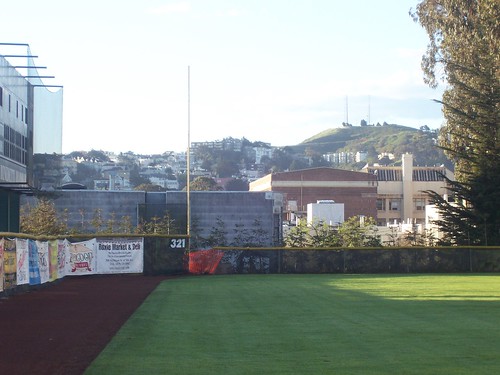
In spite of its placement on a quiet corner of The Hilltop, Benedetti Diamond and the Dons baseball team has secured a more prominent position in the annals of USF's athletic tradition which only figures to grow.
“Some of these nuns look real cute hefting those big steins of beer…”*
 Tucked away in a corner of the bottom floor of the UC Building, the bare, plain room of the Fog 'n Grog, with its yellowish walls and red variations of checkered flooring, does not give a hint of its glory days as "The Place" on campus that students, faculty, staff, Jesuits, and neighbors went to kick back, enjoy a cold beer, and mingle with one another. Opened on July 6, 1973, led by USF and then-food services ARA-Slater (now ARAMARK), it was the first on-sale beer hall on a college campus in California. The campus beer license was approved in May, ending a five year negotiation with the Alcoholic Beverage Control Commission. The campus bar opened its doors as a trial run during summer with the name "Fog 'n Grog”, a winner in a campus contest. It fast became popular among the students attending summer school, faculty members and conference guests- 550 Sisters and Jesuits attending a Symposium on Ignatian Spirituality.
In a San Mateo Times article dated August 7, 1973, John F. Marshall, then USF's vice president for student development said that the campus bar was a great way for students and faculty to get together and converse. "I think the Fog 'n Grog will be an incentive for them to stick around and enjoy some of the extras that go with a good education- meeting more people, getting to know them better, a chance to get in on campus activities," he said. With its dark wood panels, low lighting, and L-shaped bar, not to mention seating for at least 120 people, open hours from 7 to 11 each night, and .30 cent beers, people from the USF community, as well as those outside, greatly took advantage of the space. The university and food services struck gold; according to Fr. Michael Kotlanger, S.J., archivist at Gleeson Library, in its first week the bar had a profit of approximately $2,000. Aside from ample lounging areas, the bar also provided entertainment. It had a dart board, a television, music streaming from KUSF, and musical and dramatic productions. Kotlanger recalls, "We had a great time."
 It wasn’t all fun and games; the campus bar’s beer license had strict rules to follow. Only beer could be served, no wine or hard liquor were permitted. No beverages were allowed to leave the premises. Only persons 21 years of age and older could enter the bar. An adult was to remain at the entrance each night and require two IDs from patrons, one with a photo.
Unfortunately, the bar was closed down in the 80s. There was no information in archives about the closing of the bar and the people I spoke with don't recall the exact date or why it closed. Kotlanger mentioned that it was shut down because of the school’s concern about binge drinking among students and the liability issues involved if there were any mishaps. Fr. Vernon Ruland, S.J., said it had something to do with the drug culture of the time overlapping with the drinking culture. Whatever the reason, the next time you find yourself in the Fog ‘n Grog, whether it's for some club meeting or if you just happen to wander in, don’t let the drab fool you. Take a moment to reflect that at our very campus, over 30 years ago, the first campus pub in California was opened and in the very walls you are standing in, people came together to share good beer, good laughs, and good times. *James W. Kelly Jr., Director at Office of Public Information at USF (1973) – quoted many times in numerous articles on USF’s bar